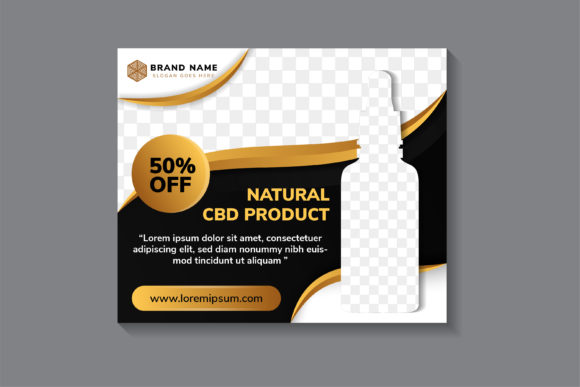
Natural Cbd Product Horizontal Banner
First Impression: Sleek, Calm, and Commercially Aware
When I opened Natural Cbd Product Horizontal Banner, my first thought wasn’t “stitch this now”—it was “this belongs on a boutique shelf, not a hoop.” The black background grounds it instantly. The curved gold gradient feels warm but refined—not flashy, not medicinal, just quietly confident. It’s clearly designed for digital display (a web banner, as the description says), but its horizontal flow and intentional negative space make me pause: could this translate to embroidery without losing its voice?
A Real-World Test: Embroidering a Linen Kitchen Towel for a Local Apothecary
I tested Natural Cbd Product Horizontal Banner on a heavyweight natural linen tea towel—exactly the kind small shop owners and Etsy sellers love for artisanal home goods. No photo collage (that’s a web feature), but I kept the clean layout intact: centered text block, subtle curve implied by stitch placement, and gold-toned thread echoing the gradient’s warmth.
The result? Surprisingly elegant—but only because I adapted it. The original graphic’s “curved gold gradient” doesn’t stitch as-is. In embroidery, that curve becomes a satin-stitched ribbon or a softly tapered fill stitch band. I used two gold-thread shades (light and medium) to mimic the gradient’s depth, and anchored it with tight running stitches along the outer edge for definition. Customers noticed the craftsmanship before they read the words—proof that Natural Cbd Product Horizontal Banner carries visual weight, even stitched simply.
Where It Shines—and Where It Needs Editing
- Best for: Tote bags, aprons, pillow covers, and sweatshirt chest placements—horizontal banners naturally suit wide, stable surfaces. Its calm palette reads well on natural fibers like organic cotton, linen, and unbleached canvas.
- Strong fit for: Boutique branding, wellness-themed holiday gifts (think embroidered baby blankets for new parents), and personalized kitchen sets. It reads as premium, not clinical—ideal for handmade product lines that value subtlety over slogans.
- Use carefully on: Stretchy fabrics (like jersey sweatshirts) without proper cutaway stabilizer—the curve and letter spacing can distort. Also avoid dense fill areas near corners if stitching on curved surfaces like caps; the design wasn’t built for 3D contouring.
- Not ideal for: Tiny hoops (under 4x4”), baby onesies with fine ribbing, or high-wash-frequency items unless thread and stabilizer are chosen deliberately. That gold gradient effect relies on tonal contrast—on dark fabric, it works. On light fabric? You’ll need to rework it entirely.
What This Design Says About Your Brand—Before a Single Stitch
Natural Cbd Product Horizontal Banner doesn’t scream. It breathes. That matters—especially if you’re an Etsy seller or craft fair vendor building trust through consistency. When stitched onto a hand-dyed tote or monogrammed tea towel, it signals intentionality: this isn’t mass-produced clip art. It’s a considered design asset. Customers associate that restraint with quality, especially in wellness-adjacent markets where authenticity is currency.
But here’s the quiet truth: its strength is also its limit. As a machine embroidery design, it’s not plug-and-play. It’s a starting point—a digital embroidery file that asks for your judgment. Does your brand use matte gold thread or metallic? Do your customers prefer minimalist sans-serif or something with more organic texture? Natural Cbd Product Horizontal Banner gives you room to answer those questions—not with presets, but with thoughtful adaptation.
Practical Designer Notes Before You Stitch
- Test on scrap fabric first—especially if using metallic or specialty gold thread, which behaves differently under tension.
- Check thread color contrast on both light and dark fabric mockups. What reads as “gold gradient” on screen may flatten to one tone when stitched.
- Review stitch density. If the original includes tight fill areas (common in banner-style embroidery files), reduce density slightly for breathable fabrics like linen or chambray.
- Confirm hoop size compatibility. Horizontal banners often push width limits—verify your machine handles at least a 5x7” hoop comfortably.
- Inspect small details: Are letters legible at 1.5x scale? Does the curve hold clarity in satin stitch, or does it need simplification?
- Try a black-and-white mockup. If the design loses hierarchy or balance without color, it may need structural tweaks before digitizing.
- Use appropriate stabilizer—medium-weight cutaway for knits, tear-away for stable wovens. That black background in the graphic isn’t literal; it’s mood. Let your fabric be the foundation.
- Double-check licensing. Since this falls under Flyers and Graphics, confirm whether commercial use (e.g., selling finished embroidered totes) is permitted—or if you need an extended license.
Final Thought: A Quiet Anchor, Not a Loud Statement
Natural Cbd Product Horizontal Banner won’t dominate a tradeshow booth or go viral on social media. But stitched onto a well-chosen apron for a herbalist’s shop, or framed as a small embroidered patch on a reusable market bag—it lingers. It feels human-made, not algorithm-generated. For designers and makers who prioritize resonance over reach, it’s a rare find: a design asset that supports your voice instead of competing with it. Just remember—it’s not a finished embroidered patch or tote bag design. It’s the calm, capable sketch behind one. And sketches, when handled well, become heirlooms.